

Blog
Why Your Hair Starts Falling Out 3 Months After a Hysterectomy (And What Actually Helps)

This is for informational purposes only. For medical advice or diagnosis, consult a professional.
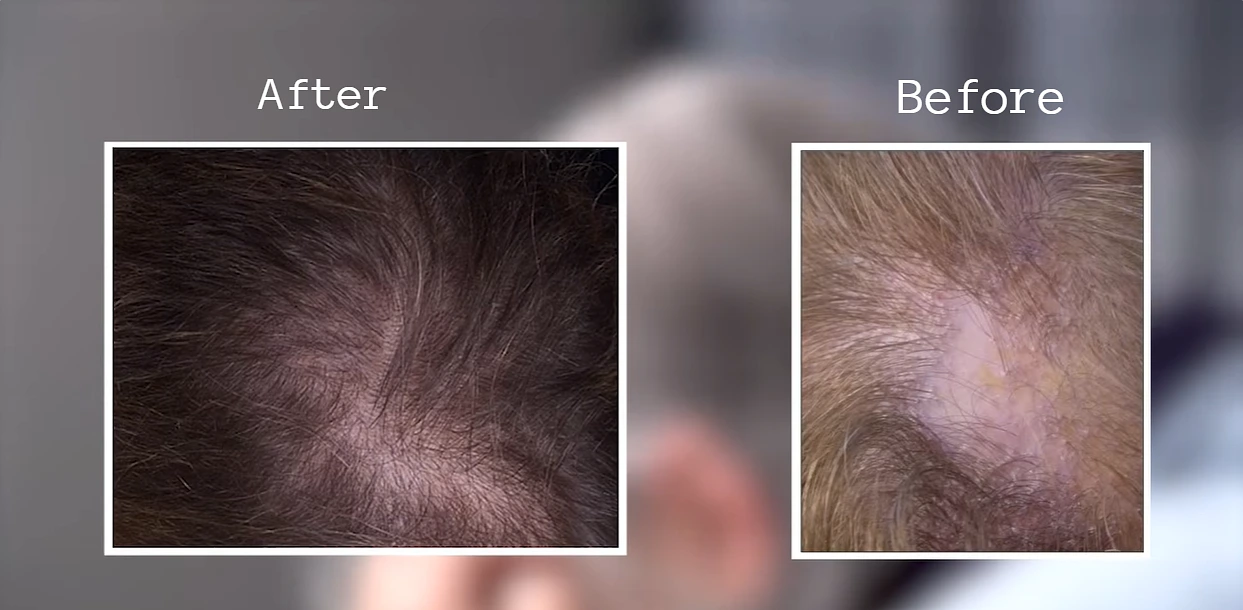
Hair does not grow all at once. On a healthy scalp, roughly 85% of hairs are in the growing phase and about 15% are resting before they shed, which is why losing fifty to a hundred hairs a day is unremarkable. A follicle grows for several years, rests for around three months, and then lets the old hair go as a new one pushes up underneath.
Surgery interferes with that arrangement. The body diverts resources to wound healing and treats hair as the low priority it is, so anaesthesia, blood loss, raised cortisol and a week or two of poor appetite together push an unusually large batch of follicles out of growth and into rest. Under significant physiological stress that shift can affect a very large share of the growing hairs.
They do not fall then. They fall when the resting phase runs out, two to four months later, and that is the entire explanation for why your surgery in January turns into a shedding problem in April. The condition has a name, telogen effluvium, and surgery is one of its most reliable triggers.
The follicles themselves are dormant rather than damaged, which is the part worth holding on to while you are standing over the drain.
| Period | What is happening |
|---|---|
| Surgery to 2 months | Follicles shifting into rest. Nothing visible yet. |
| Months 2 to 4 | Shedding begins and becomes obvious. Often heaviest here. |
| Months 4 to 6 | Shedding at its most visible, then beginning to taper. |
| Months 6 to 9 | Fine new hairs appear along the hairline and temples. Shedding drops noticeably. |
| Months 9 to 18 | Density returns for most women. New hair grows at roughly half an inch a month. |
Shedding stops well before the mirror improves, and that gap catches people out badly. New hair has to grow several inches before it reads as fullness rather than fluff, so there is a stretch of months where things are genuinely getting better and look no different.
The Ovary Question
If your ovaries were removed along with the uterus, something else is running alongside the surgical shedding.
The ovaries are the main source of oestrogen and progesterone, and removing them produces immediate surgical menopause rather than the gradual decline of a natural one. That speed is why the hair effect tends to be sharper than what women describe going through menopause naturally. The follicles get no time to adjust.
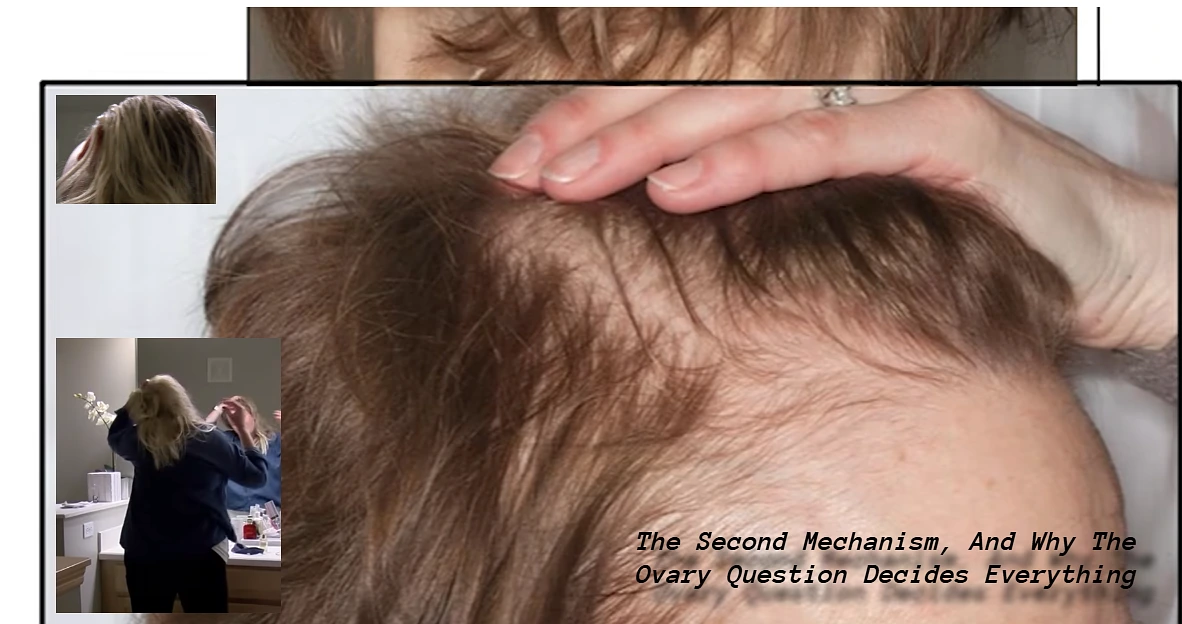
Falling oestrogen shortens the growing phase, so hairs enter shedding earlier than they otherwise would. Falling progesterone weakens a natural brake on 5-alpha reductase, the enzyme that converts testosterone into DHT, and DHT binds to receptors in the follicle and gradually miniaturises it. That second process is the mechanism behind female pattern hair loss, and it is slow, ongoing and quite different in character from a one off shed.
Surgical telogen effluvium resolves by itself. The hormonal component generally does not, because the hormonal change is permanent unless something addresses it. Knowing which of these applies to you changes whether the right response is patience or a proper appointment.If The Ovaries Were Left In
Then the temporary mechanism is the likely explanation, though not always in isolation.
Hysterectomy can disturb blood supply to the ovaries even when they are left structurally intact, and some women find their hormone levels shift more than anyone anticipated in the months afterwards. What usually results is a milder version of the same picture rather than a clean exemption from it.
If shedding has not settled by around nine months, or you are seeing a widening centre part rather than diffuse thinning, raise that specifically instead of continuing to wait.
Ferritin is The Test That Gets Skipped
A comparative study of a hundred women, half with telogen effluvium and half without, found mean serum ferritin of 24.30 ng/mL in the affected group against 44.78 ng/mL in controls, and 28% of the telogen effluvium cases had ferritin below 15 ng/mL where none of the controls did. In a separate review of nearly a thousand telogen effluvium patients, low ferritin turned up in 44% of them, alongside strikingly high rates of vitamin D deficiency.
Surgery involves blood loss and the appetite afterwards is usually poor, so this is a common problem after a hysterectomy, and it is worse in women who were already depleted from heavy bleeding in the years leading up to it.
The detail that matters when you book the test is to ask for ferritin rather than only haemoglobin. Haemoglobin can sit comfortably in range while iron stores are running low, and iron deficiency without anaemia shows up in around a fifth of telogen effluvium cases, detectable only through ferritin. Have thyroid function done at the same appointment, since thyroid disorders produce a very similar diffuse shed and are easy to overlook when there is an obvious surgical explanation sitting in front of everyone.
Getting this done early rather than at month eight can genuinely shorten how long the whole thing runs.
Hormones, If That Applies to You
For women in surgical menopause, hormone therapy is the option that addresses the hormonal mechanism directly rather than waiting for something that will not resolve on its own, and starting sooner tends to produce better hair outcomes than starting later.
It is not a hair decision though. Hormone therapy involves bone density, cardiovascular considerations and your personal and family history, and it belongs with a gynaecologist or GP who can weigh all of that together. What I would push you towards is raising the hair specifically during that conversation, because it frequently goes unmentioned in post-hysterectomy appointments and it is a perfectly legitimate thing to bring up.
Topical minoxidil is worth asking about alongside it. A small open label trial in telogen effluvium found terminal hair counts rose meaningfully by week four with twice daily 5% minoxidil, though with twelve participants it should be read as encouraging rather than established.
Eating, Handling, And What to Leave Alone
Protein first, because hair is keratin and your healing demands are already raised. Adequate calories matter for the same reason, and under-eating through recovery prolongs the shedding rather than shortening it.
Vitamin D and iron are worth correcting if a test showed you are low, tested rather than assumed.
Skip the general hair supplement unless bloodwork pointed at something. Biotin helps biotin deficiency, which is genuinely rare, and it interferes with several lab assays including thyroid and cardiac markers, which is an awkward thing to have on board given everything above.
For handling, keep styles loose, cut the heat down and avoid tight ponytails on follicles that are already stressed. None of this regrows anything. It only stops you adding breakage to a shed you are already dealing with.
One thing about judging progress. Watch whether the shedding is reducing rather than whether your hair looks fuller, because those two things are separated by months, and women who go by fullness alone often decide nothing is working at precisely the point where it has started to.
Signs That This is Something Other Than a Oost-Surgical Shed
Round bald patches instead of diffuse thinning across the scalp. Scalp pain, scarring or heavy scaling. A hairline that is steadily receding, or a centre part that keeps widening, which points towards pattern hair loss rather than effluvium. Shedding still running heavy past nine to twelve months. Or hair loss sitting alongside fatigue, weight change and temperature intolerance, which points at the thyroid.
A dermatologist can separate these on examination in a way that no article can manage, and post-hysterectomy hair loss is common enough that asking about it is not making a fuss.
If you want one thing to do this week, book the blood test and ask for ferritin and thyroid by name. Most women who go through this get their hair back. The ones who get it back faster are usually the ones who found out early that something correctable was sitting underneath it.