
Blog
Impetigo, Eczema, or Erysipelas: How to Read a Rash That Keeps Coming Back on Your Child’s Face

The cream works. The rash clears. A fortnight later it is back, same cheek, same child health, and you are exactly where you started.
Most parents assume the treatment failed. Usually it did not. What is actually happening is that two of these conditions feed each other, and until somebody separates them, the cycle simply keeps turning.
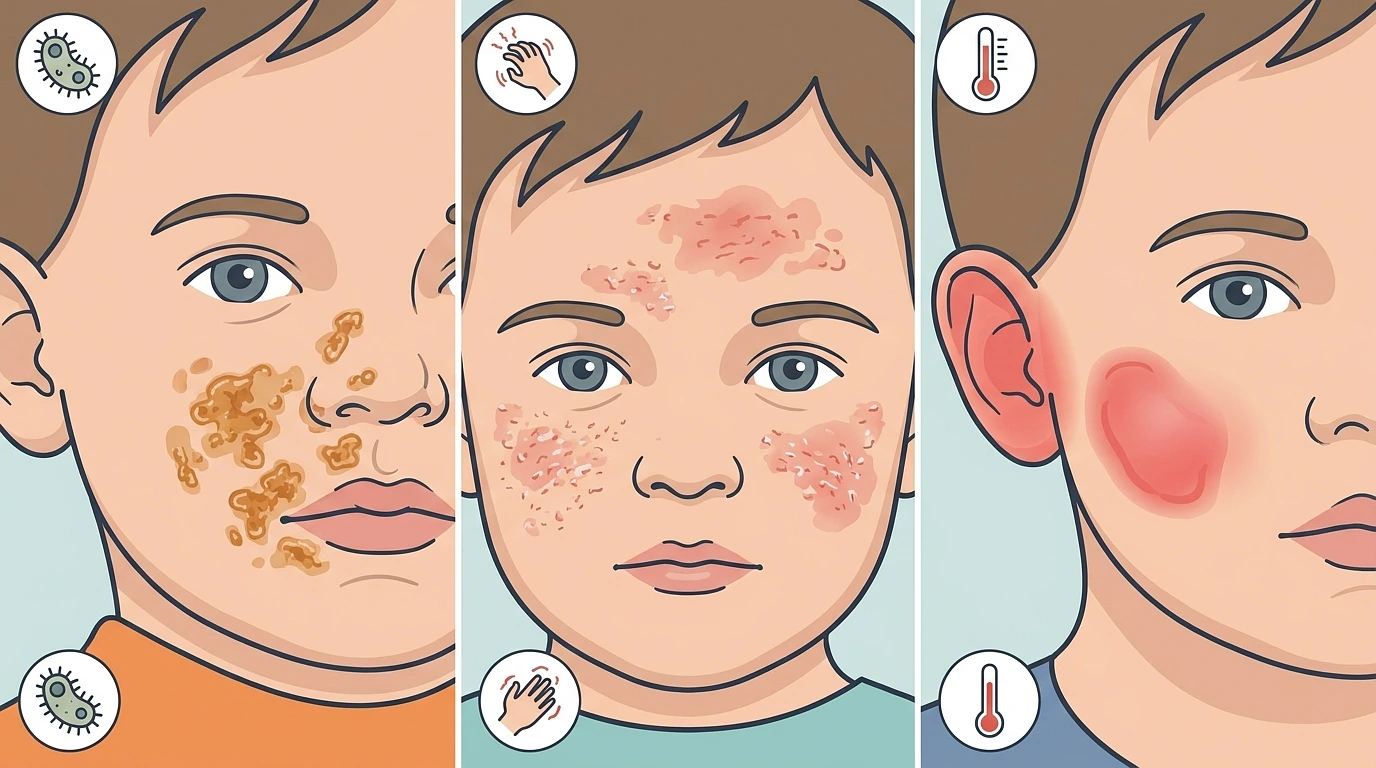
Three things tell them apart: the texture of the skin, the behaviour of the edge, and whether the child is unwell in themselves.Golden-yellow crusts point to impetigo, a surface bacterial infection. Dry, rough, intensely itchy patches with blurred edges point to eczema, which is not an infection at all. A bright red, hot, shiny swelling with a sharp raised border, in a child with a high fever, points to erysipelas, which needs a doctor the same day.
| Impetigo | Eczema | Erysipelas | |
|---|---|---|---|
| What it is | Surface bacterial infection | Skin barrier defect | Deeper bacterial infection |
| Cause | Staph aureus, Strep pyogenes | Genetics, immune response | Group A Streptococcus |
| Give-away sign | Honey-coloured crusts | Dry, rough, badly itchy | Bright red, shiny, hot, swollen |
| The edge | Irregular, spreading sores | Blurred into normal skin | Sharp, raised, traceable |
| The child | Usually well | Well but miserable | Clearly ill, high fever, chills |
| Contagious | Highly | No | No |
| Urgency | Doctor within days | Routine appointment | Same day |
Golden Crusts Mean Impetigo
If you see crusts the colour of honey, stop guessing. Nothing else on a child’s face makes that particular golden-brown scab.
It begins as small red bumps or blisters, usually clustered around the nose and mouth. These start as tiny vesicles, rupture within a day or two, weep briefly, then dry into a honey-coloured crust sitting on a moist red base. The infection lives on the surface of the skin care, which is why it travels so easily on fingers, towels and shared pillows, and why it moves through a nursery class in a week. Some families call it school sores for exactly that reason.
It is one of the most common childhood skin conditions worldwide, and the highest incidence falls between the ages of two and five. Children with it are usually well in themselves. A mild fever or slightly swollen glands can occur, so do not rule it out because your child feels a touch warm, but they are not typically ill.
Now the part that matters for recurrence. If a child gets impetigo again and again, there are broadly two explanations:
- Nasal carriage. Some children carry Staphylococcus aureus harmlessly inside the nose and reseed their own skin each time they rub it. In bullous impetigo, roughly half of children test positive for the toxin-producing bacteria in the nose or throat. This is testable and treatable.
- Something itchy underneath that they keep scratching open, which is the far more common answer.
Eczema Is The Door, Not The Infection
Eczema, also called atopic dermatitis, is not an infection. It is a fault in the skin barrier, driven by genetics and immune response. On a child’s face it looks dry, rough and inflamed, and it itches badly enough to wake them at two in the morning. It flares with cold weather, harsh soaps, dust, and whatever else that particular child reacts to.
Here is the connection that explains the whole cycle. Broken skin is an open door. Every scratch opens microscopic cracks, and bacteria that normally sit harmlessly on the surface walk straight in. Doctors call the result impetiginised eczema, and it is one of the most common things a paediatric dermatologist sees.
Which is why treating the infection alone never ends anything. You clear the bacteria, the crusts go, the door stays open, and a fortnight later you are opening the same tube again. Controlling the eczema is what stops the repeat visits.
Signs Eczema Has Become Infected
According to the American Academy of Dermatology, the signs worth watching for are honey or yellowish-orange crusting appearing on top of the usual patches, pus-filled blisters, sores that resemble cold sores, swollen red bumps, or redness streaking outward. Flu-like symptoms or a temperature of 100.4°F and above needs immediate medical care.
Their guide to spotting infection in a child's eczema is worth bookmarking if this is your family's pattern.Erysipelas Is The One That Cannot Wait
Everything above can wait for an appointment in a few days. This cannot.
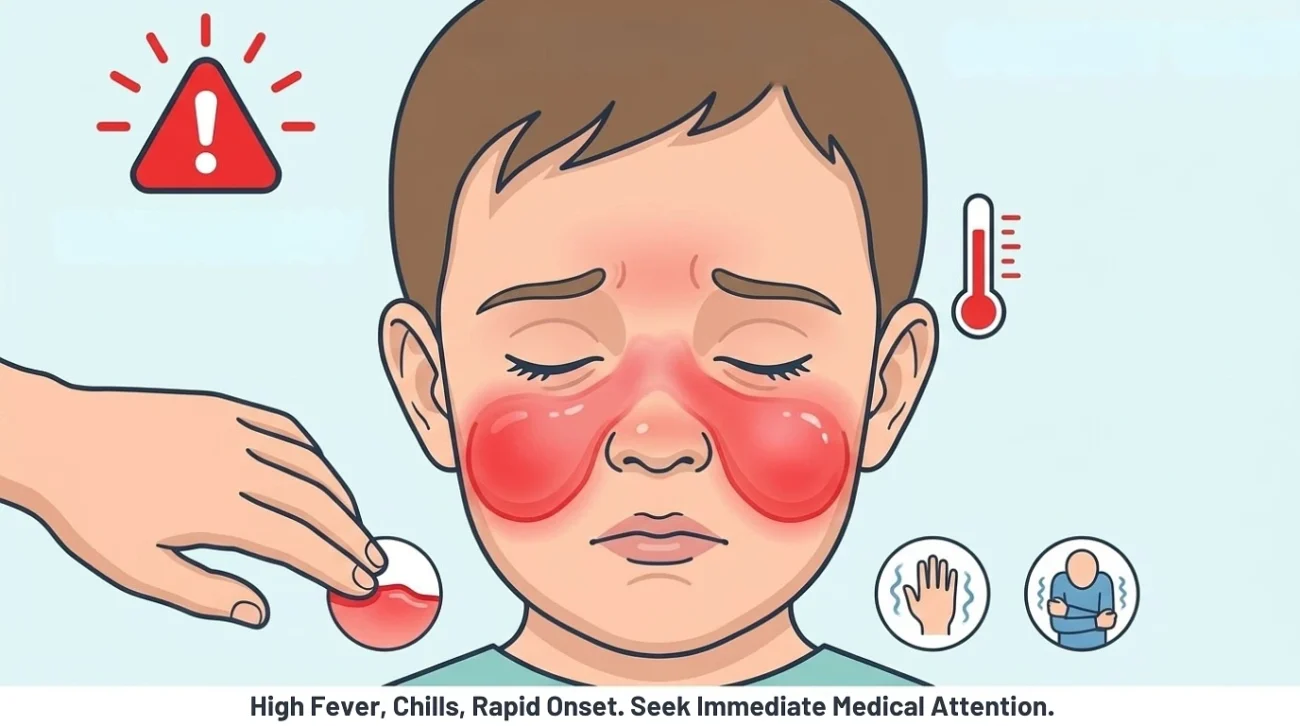
Erysipelas, sometimes called St Anthony’s fire, is a deeper infection reaching the upper dermis and the small lymph vessels beneath. The skin turns brilliant red, hot, firm and shiny. On the face it classically appears across both cheeks and the bridge of the nose in a butterfly pattern, described in clinical texts as a sharply demarcated, glistening, smooth, hot plaque. It is most common in young children and in older adults.
The edge gives it away. Run a finger along it and you can feel precisely where infected skin stops and healthy skin begins. That firm, tender, sharply bordered plaque is what separates it from the very superficial nature of impetigo.
And the child is properly ill: high fever, chills, shivering, unusual drowsiness, arriving over hours rather than days. It often follows a small break in the skin, and an eczema scratch is more than enough. It can also come on the back of a recent sore throat or cold.
Faces deserve extra caution. The blood supply is dense, the eyes are close, and infection here can move quickly.
The Look-Alike Nobody Warns Parents About
There is a fourth possibility, and it is the most urgent of all.
Eczema herpeticum happens when the cold sore virus, herpes simplex, infects eczema-damaged skin. It looks quite different from bacterial crusting. Instead of golden crusts, you see uniform, punched-out erosions or small blisters that all look identical to one another. The child is usually feverish and in real pain.
This is a medical emergency. If someone in the house has an active cold sore and your child’s eczema suddenly erupts with clusters of identical little pits or blisters, go to a doctor immediately and say plainly that you are worried about eczema herpeticum. It responds well to antiviral treatment, and badly to delay.
Two milder look-alikes are worth knowing too. Ringworm on the face, or tinea faciei, forms a ring with a raised scaly edge and a clearer centre, and it needs antifungal rather than antibiotic treatment. Cold sores themselves cluster on the lip border and tend to recur in the same spot.
What This Looks Like On Brown And Darker Skin
Almost every medical photograph of these conditions shows fair skin, which leaves many parents comparing their child against pictures that do not match.
On brown, wheatish and darker skin, redness reads as deeper purple, greyish, or simply darker than the surrounding skin rather than bright pink. Inflammation shows itself more through swelling, warmth and shine than through colour. Eczema often looks ashy or grey when dry, and may appear as small raised bumps rather than flat patches.
Two practical consequences follow. Judge erysipelas by heat, firmness, the sharp edge and the fever, not by how red it looks. And after any of these clears, darker skin is more prone to leaving post-inflammatory marks that fade over weeks to months. These are marks, not scars, and picking or scratching is what turns one into the other.
When To Get Help The Same Day
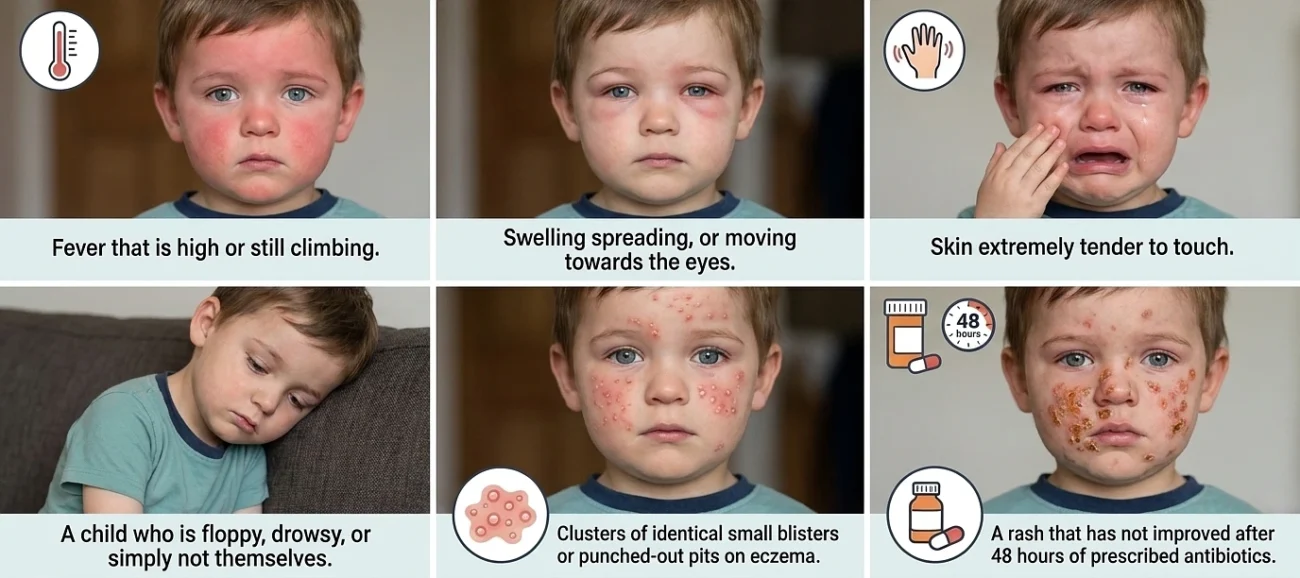
- Fever that is high or still climbing.
- Swelling spreading, or moving towards the eyes.
- Skin extremely tender to touch.
- A child who is floppy, drowsy, or simply not themselves.
- Clusters of identical small blisters or punched-out pits on eczema.
- A rash that has not improved after 48 hours of prescribed antibiotics.
That last one matters more than parents realise. Antibiotics not working within two days usually means the wrong organism, the wrong drug, or something deeper than anyone assumed.
What To Do With This
None of this is a diagnosis, and it is not meant to be. A rash on a child’s face that spreads, hurts, or comes with fever needs a doctor looking at it. Mayo Clinic’s page on impetigo and Cleveland Clinic’s overview of the condition are reliable reading while you wait for that appointment.
What this does give you is the better question to ask. If the pattern in your house is rash, cream, clear, rash again, the thing to raise is not a stronger antibiotic.
The infection is the symptom. The barrier is the cause.