Blog
How Quickly Does Your Skin Dry Out When Starting?

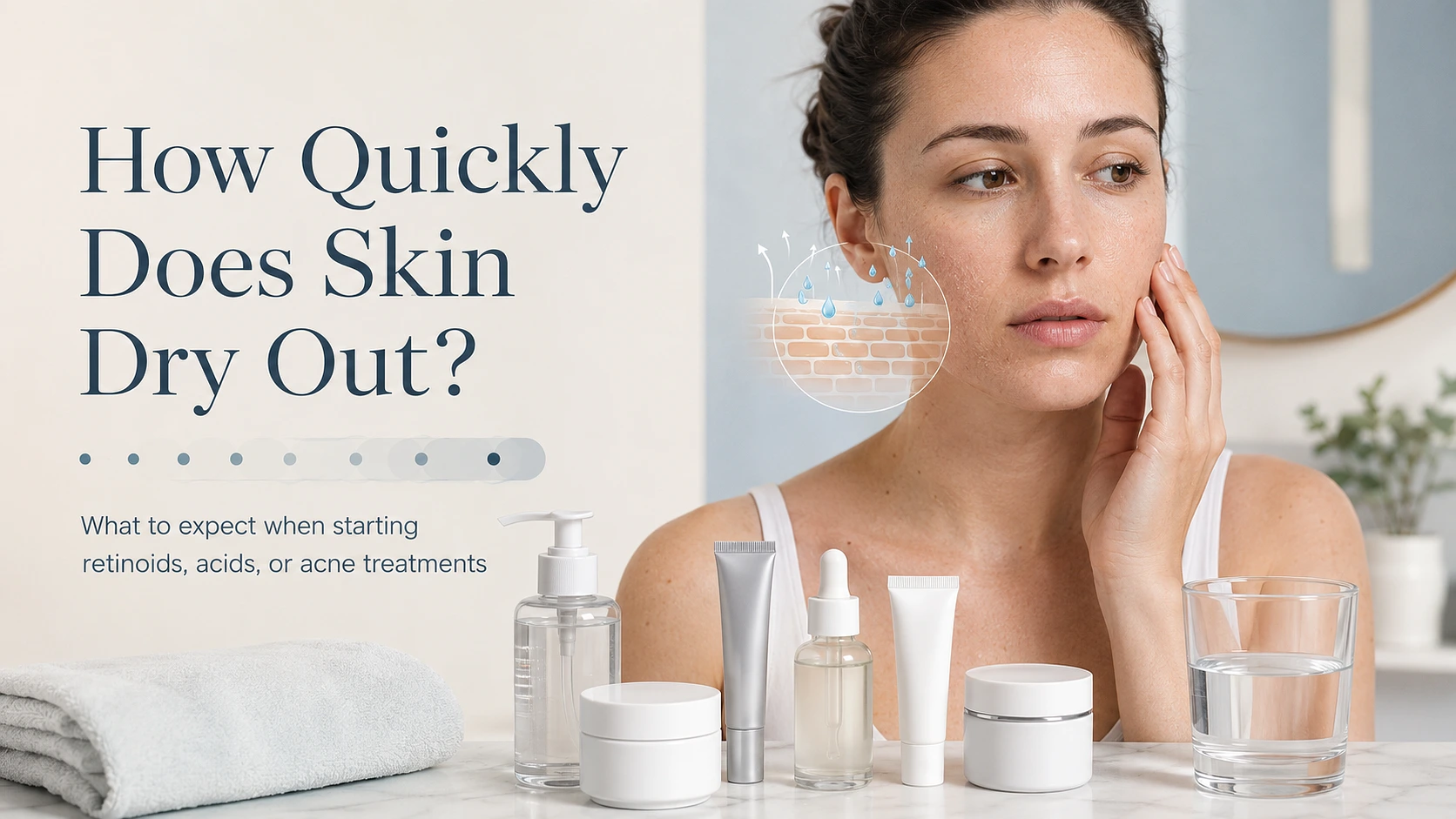
The unveiling of a highly potent skin care product is always a thrilling moment. You’ve just gotten ready for that perfect, clear skin you’ve been hoping for from a new retinoid, a potent exfoliating acid, or a prescription medication, such as Accutane.
But, let’s face it, that initial hype can escalate into downright panic once your face is feeling tight, red, and flaky a few days later. You begin to suspect you have an allergy or that you’ve permanently damaged your skin.
Don't worry you probably haven't. Knowing exactly how quickly this dryness hits, and why it happens, is your ultimate superpower for surviving the adjustment phase. Let's break down exactly what to expect.Why Does “Starting” Make You Flake?
The only way to figure it out is to consider the way your skin defends itself. The topmost layer of skin (stratum corneum) is similar to a protective brick wall. The “bricks” are skin cells and the “mortar” is a complex mixture of lipids, ceramides and fatty acids that keep moisture in your skin and keep irritants from outside sources from entering.
Add a high level of active ingredient, and temporarily upset this entire system. These actives either accelerate the removal of skin cells or vigorously exfoliate the skin’s surface oils. As the lipid matrix on your skin is eroded, your skin can’t replace it fast enough to keep up with the loss, and moisture literally escapes the air. Dermatology-wise it’s called Transepidermal Water Loss (TEWL).
Timelines Across Major Active Ingredients
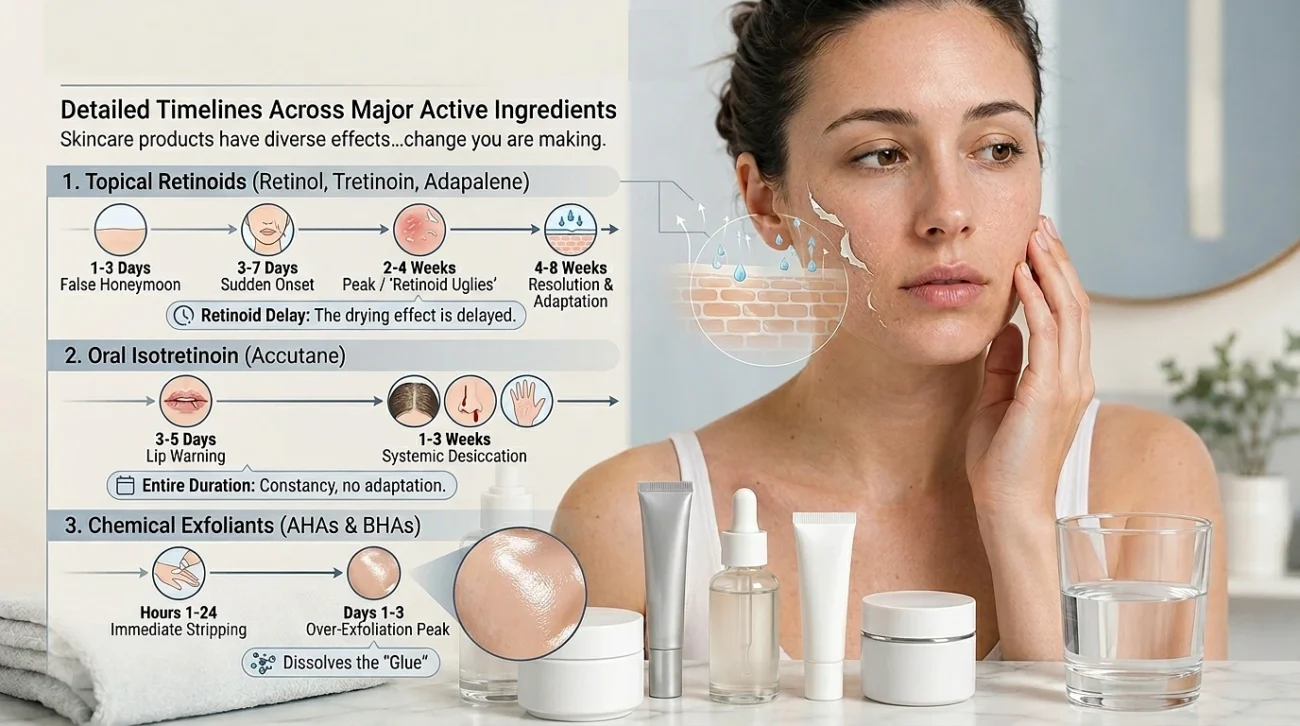
There are a wide variety of skincare products, each with its own set of characteristics. Dryness may come on suddenly, or develop as a late reaction several days later, depending on the change you are making.
1. Topical Retinoids (Retinol, Tretinoin, Adapalene)
Starting a topical vitamin A derivative kicks off an adjustment phase known as retinization.
- Days 1 to 3 (The False Honeymoon): Your skin usually feels perfectly fine maybe even exceptionally smooth. The active molecules are penetrating the deeper layers, but they haven’t forced rapid cellular changes to the surface yet.
- Days 3 to 7 (The Sudden Onset): The accelerated cellular turnover finally catches up to the surface. You will begin to notice a distinct tightness around your mouth, nose, and eyes. Foundation or concealer will start to “cake” or look patchy.
- Weeks 2 to 4 (The Peak / “Retinoid Uglies”): This is the absolute zenith of your dryness. Flaking, localized peeling, and mild redness are incredibly common. Everyday items like basic cleansers or light moisturizers may suddenly sting when you apply them.
- Weeks 4 to 8 (The Resolution): If you stay consistent and focus heavily on barrier support, your skin will build a tolerance. The rate of lipid production catches up to the cellular turnover, and the dryness naturally clears up.
The Retinoid Delay: Because retinoids work by altering how your skin cells behave, the drying effect is always delayed. Never assume that because your face isn’t dry on Day 2, you can safely apply a prescription retinoid every single night!
2. Oral Isotretinoin (Accutane)
Oral isotretinoin is more than just a topical cream for specific areas; it is a systemically acting drug, meaning that it has a systemic effect, directly shrinking your body’s oil glands. This makes the dryness extreme, full and unconditional.
- Days 3 to 5 (The Lip Warning): Your lips are always the first line of defense to fall. They will become extraordinarily dry skin, chapped, and prone to cracking at the corners.
- Weeks 1 to 3 (Systemic Desiccation): The oil suppression reaches full effect. Dryness spreads rapidly from your face to your scalp (meaning you won’t need to wash your hair nearly as often), the insides of your nasal passages (which can cause minor nosebleeds), and your arms and legs.
- The Entire Duration: Your skin will not “adapt” to oral isotretinoin over time. The severe dryness will persist at a constant state for your entire prescription course, requiring heavy clinical emollients.
3. Chemical Exfoliants (AHAs & BHAs)
Alpha Hydroxy Acids (glycolic acid and lactic acid) and Beta Hydroxy Acids (salicylic acid) dissolve the “glue” that cements cells together, which removes dead cells.
- Hours 1 to 24 (The Immediate Stripping): If an acid is applied in a high concentration or left on too long, dryness can occur almost immediately. Salicylic acid plunges deep into pores and strips away surface sebum rapidly.
- Days 1 to 3 (The Over-Exfoliation Peak): If you overuse acids right out of the gate, your skin will take on a tight, “squeaky clean” appearance. It might shine like glass, but it will feel uncomfortably parched. Flaking usually sets in by forty-eight hours.
Here is a quick comparative overview of what to expect when introducing these core treatments to your skin routine:
| Ingredient / Treatment | First Onset | Peak Dryness | Primary Characteristics |
| Topical Retinoids (Tretinoin, Retinol) | 3 to 7 Days | 2 to 4 Weeks | Localized peeling around the mouth and nose, stinging, transient redness. |
| Oral Isotretinoin (Accutane) | 3 to 5 Days | Continual | Severe, systemic dryness affecting lips, face, nasal passages, and body. |
| Salicylic Acid (BHA) | 1 to 2 Days | 3 to 5 Days | Instant removal of surface oils, dry patches over active breakouts. |
| Glycolic Acid (AHA) | 1 to 2 Days | 2 to 4 Days | Surface crinkling, tight glassy sheen, generalized fine flaking. |
| Benzoyl Peroxide | 2 to 4 Days | 1 to 2 Weeks | Chalky, powdery dryness, surface irritation, scaling. |
The Survival Protocol: How to Mitigate Early Dryness
It is normal to feel dryness when beginning a powerful active ingredient, however, it can be a pain in the arse. Carefully planned application techniques will help you maintain moisture barrier without compromising results.
The Sandwich Method
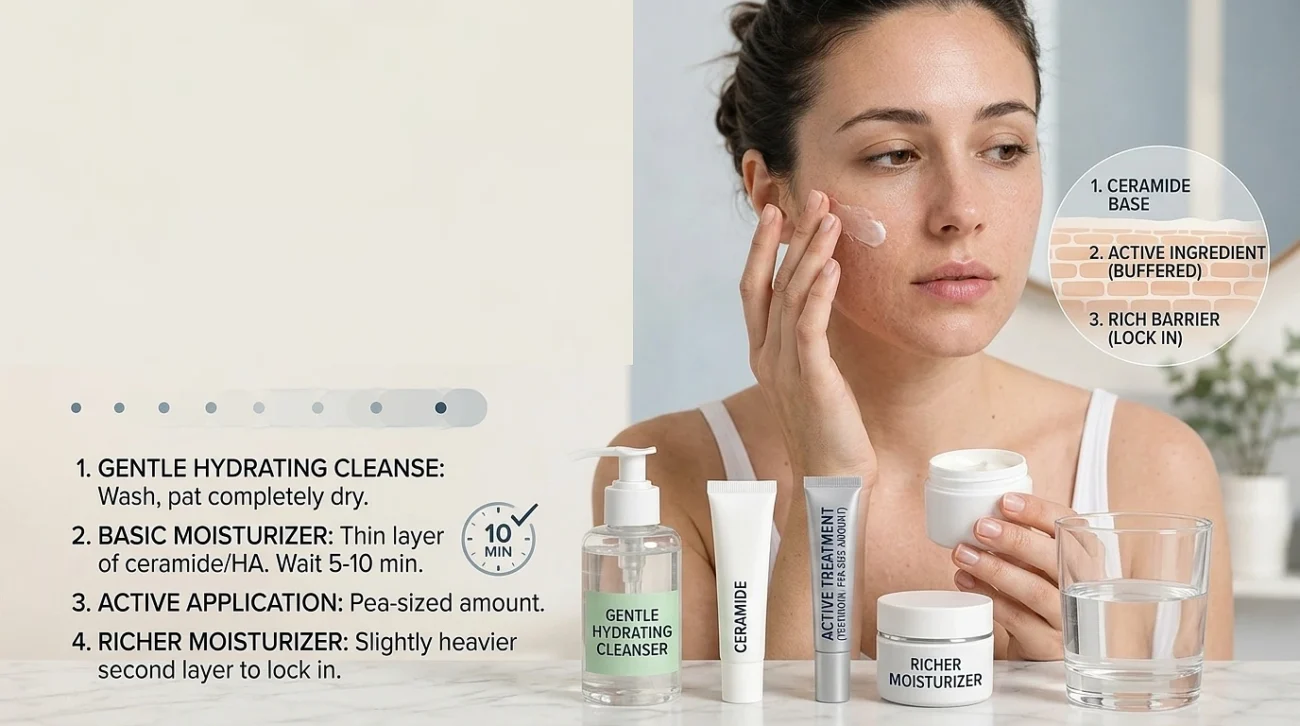
Highly recommended for topical retinoids, this method creates a physical buffer that slows down how quickly the active ingredient absorbs into your skin.
- Wash your face with a gentle, non-foaming, hydrating cleanser and pat it completely dry.
- Apply a thin layer of a basic, fragrance-free moisturizer containing ceramides or hyaluronic acid. Wait 5 to 10 minutes for it to sink in fully.
- Apply a pea-sized amount of your active treatment (like Tretinoin) evenly across your face.
- Follow up with a second, slightly heavier layer of your moisturizer to lock everything in and prevent moisture evaporation.
Short-Contact Therapy (SCT)
In the case of a very sensitive skin, you may use a Short-Contact Therapy with ingredients such as Benzoyl Peroxide or Tretinoin. Apply on clean skin, leave on for 15-30 minutes, and then gently remove with lukewarm water. Immediately use evening moisturizer afterward. Your skin still benefits in the long run without having been irriated over long periods.
Distinguishing Normal Dryness From a Broken Barrier
How do you know if your skin is simply adjusting or if you have crossed the line into genuine damage?
- Normal adjustment dryness looks like mild, localized flaking, a temporary feeling of tightness that disappears right after you apply moisturizer, and minimal redness.
- A damaged skin barrier is manifested by skin, which appears constantly raw, angry, bright red. Even the least irritating, least exotic moisturizers cause intense burning and tiny, itchy fluid-filled bumps on the face, you’re overstepping your tolerance.
When barrier is compromised, you need to stop all active ingredients and just use moisturizing and repairing barrier for at least 10 – 14 days.