
Blog
Sacred Mudras: The 5 Hand Positions Yogis Have Used for 3,000 Years

The first time a yoga teacher told me to touch my thumb to my index finger and “seal the energy,” I’ll be honest, my inner skeptic rolled its eyes so hard I nearly pulled something. Energy seals. Sure. I was there for the stretching, not the finger choreography. Then I actually held the position for ten quiet minutes, and something I wasn’t expecting happened: I noticed my hands. Really noticed them, the way you notice a sound only after it stops. That noticing turned out to be the whole point, and it turns out there’s a perfectly good reason your brain lights up when your fingers do something deliberate.
What a Mudra Actually Is
Strip away the incense for a second. A mudra is simply a fixed, deliberate position of the hands and fingers used during meditation or breathwork. The word is Sanskrit for “seal” or “gesture,” and the practice is woven through thousands of years of yogic and Buddhist tradition, showing up in temple carvings, in the hand positions of statues, and in the classical hatha yoga texts. The claim traditional practitioners make is that each gesture channels energy, or “prana,” in a particular way.
Here's my honest read on that claim. There is no strong clinical evidence that curling your fingers a certain way redirects a life-force nobody has measured. But dismiss the whole thing on those grounds and you miss what's actually going on, which is arguably more interesting than the mystical version. A mudra is a tiny, sustained act of focused attention anchored in the most neurologically loud part of your entire body. That last part isn't mysticism. That's a map of your brain, and it explains the tradition better than "energy" ever could.
Why the Hands? The Brain Has an Answer
Picture a strange little figure neuroscientists call the cortical homunculus. It’s a model of the human body redrawn to scale, not by physical size, but by how much brain territory each body part commands. It looks grotesque: a creature with a modest torso, spindly legs, and enormous, swollen hands and lips, like a caricature drawn by someone who’d only ever felt a human, never seen one.
That distortion is real, and it's the key to this entire tradition. According to the documented neuroscience, the hands occupy a disproportionately large area of the motor and sensory cortex, far more than their physical size would justify, because they carry extremely high nerve density and demand extraordinarily fine control. The mapping goes back to the pioneering brain-surgery work of Penfield and Boldrey in 1937, and it's been confirmed and refined ever since: body parts requiring precise control, like the hands and lips, take up outsized cortical real estate while the trunk barely registers.Sit with what that means for a mudra. When you bring focused, sustained attention to your hands, you are deliberately engaging one of the largest, most richly wired regions of your brain. The yogis three thousand years ago had no fMRI and no word for “somatosensory cortex,” but through pure experiment on their own attention, they found the single richest input device the body has. They didn’t guess the hands were special. They felt it, correctly. And there’s a second layer, because these gestures were almost never held in isolation.
The Breath Does the Heavy Lifting
Nearly every mudra tradition pairs the hand position with slow, controlled breathing, and this is where the measurable physiology quietly enters the room.
When you drop into the slow breathing that mudra practice calls for, roughly five to six breaths per minute instead of the usual twelve to twenty, real things happen in your nervous system. A controlled study on slow-paced breathing at six cycles per minute found it measurably increased cardiac vagal activity, the marker of your parasympathetic “rest and digest” system, even in sessions as short as five minutes. Broader reviews of slow breathing at or below six breaths per minute link it to improved vagal tone and heart rate variability alongside reductions in cortisol, anxiety, and stress. So the calm you feel isn’t imaginary and it isn’t prana. It’s your vagus nerve responding to a breathing rate you rarely visit in ordinary life. The mudra holds your attention still; the breath shifts your physiology. Together they’re a genuinely effective focusing device dressed in ancient clothes.
The 5 Sacred Mudras
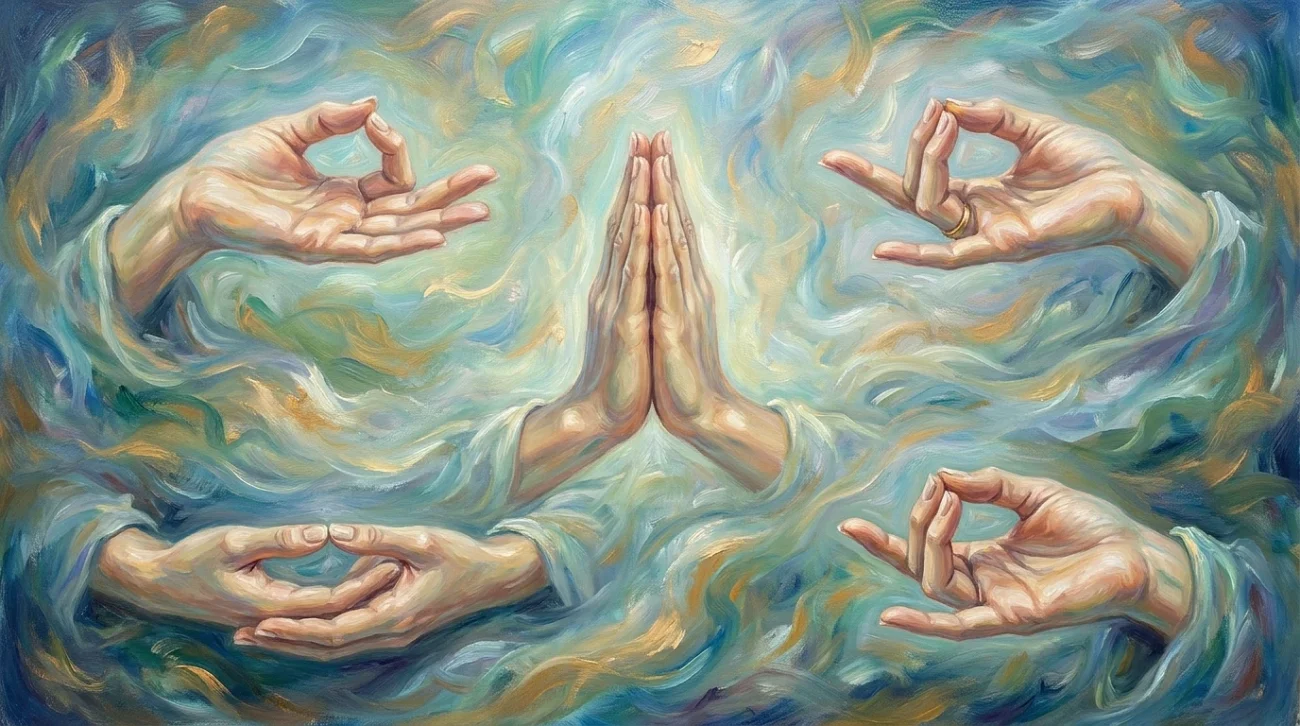
With the honest framing in place, here are the five hand positions that show up most across the tradition, what they’re said to do, and how to actually form them. Treat the “traditionally used for” column as cultural context, not medical instruction.
1. Gyan Mudra (The Seal of Knowledge):
The one everyone pictures. Touch the tip of your thumb to the tip of your index finger, let the other three fingers extend gently, rest your hands on your knees with palms up. This is the beginner’s anchor, traditionally associated with concentration and calm, and it’s the gesture I was so busy rolling my eyes at. It’s the easiest one to hold for a long stretch, which is exactly why it’s where most people start.
2. Anjali Mudra (The Prayer Seal):
Press your palms together at the center of your chest, fingers pointing up, a small hollow between the palms. You’ve made this shape your whole life without naming it. In practice it’s used to open and close sessions, a gesture of centering and gratitude, and pressing the palms together floods that outsized hand-map with symmetrical sensory input, which is part of why it feels so grounding.
3. Prana Mudra (The Seal of Life):
Fold your ring finger and little finger down to touch the tip of your thumb, keeping the index and middle fingers straight. Traditionally considered an “activating” gesture meant to rouse energy and alertness, it’s often paired with deeper breathing. Whatever you believe about the life-force framing, the finger position demands a bit more coordination, which pulls attention in more sharply.
4. Dhyana Mudra (The Seal of Meditation):
Rest both hands in your lap, right hand cradled in the left, palms up, thumb tips lightly touching to form a shallow bowl. This is the meditation posture carved into countless statues of the seated Buddha. It asks nothing of your fingers except stillness, which makes it ideal for long sits where any active gesture would eventually distract more than it helps.
5. Apana Mudra (The Seal of Digestion and Release):
Touch the tips of your thumb, middle finger, and ring finger together, index and little finger extended. Traditionally associated with cleansing and “release,” it’s another gesture that, in plain terms, gives your attention a specific, mildly demanding shape to hold. That’s not a small thing. A specific shape is far easier to return to than a vague instruction to “clear your mind.”
Quick Reference: The Five at a Glance:
| Mudra | How to form it | Traditionally used for | Best for |
|---|---|---|---|
| Gyan | Thumb to index tip, palms up | Concentration, calm | Beginners, long holds |
| Anjali | Palms together at the chest | Centering, gratitude | Opening and closing a session |
| Prana | Ring and little finger to thumb | Energy, alertness | Morning practice, waking up focus |
| Dhyana | Hands stacked in lap, thumbs touching | Deep meditation | Extended seated sits |
| Apana | Thumb, middle, ring fingertips joined | Cleansing, release | Slow breathwork, winding down |
How to Actually Try This Without the Woo
Skeptic to skeptic, here’s how to test whether any of this does anything for you, no belief required.
- Pick one mudra and hold it for five to ten minutes. Gyan or Dhyana are the forgiving ones. Consistency beats variety at the start.
- Pair it with slow breathing, aiming for around six breaths a minute, with your exhale a little longer than your inhale. This is the part the research actually supports, so don’t skip it.
- Put your attention in your fingertips, not in your thoughts about your fingertips. The point of the gesture is to give your very large hand-brain something precise to hold onto.
- Judge it by results, not theory. You don’t have to believe in prana for a slower heart rate and a quieter head to be worth ten minutes.
Three thousand years is a long time for a practice to survive, and things that useless usually don’t. Mudras endured not because the energy claims are literally true, but because their designers stumbled onto something real: the hands are the loudest instrument the nervous system owns, and pointing your attention at them, while breathing slow, is a shortcut to a calmer state that your own body will confirm if you give it ten honest minutes. My inner skeptic still doesn’t buy the energy seals. It has, grudgingly, made its peace with the fingers.